Sunday, 24 June 2012

Visit to Mamalapuram Shore Temples


Yesterday we made the trip to Mamalapuram Shore Temples to check out some temples and landmarks that were over 1,400 years old! These temples had been buried until the Tsunami in 2004.  Then, the tide receded and the temples came into view.  These temples are no longer active temples, and are more or less just tourist attractions, but they are very very cool!  We had a really good tour guide as well.

We saw a large rock that looks as though it’s about to roll off of the hill that it’s set on.  It is called Krishna’s Butter Ball.  Apparently the Hindu God Krishna had over 1,600 girlfriends, and they all brought him butter or something like that.  Hindu mythology is too much for me to remember, but they have some reasoning for why this butter ball will not move from where it is planted.  I will call it center of gravity.

After that, we went to a crocodile park where they had many, many different kinds of crocs.  My favorite animal there was the Adalabra Giant Tortoises.  I have always been a turtle person as it is, and they are magnificent!


This is me holding the Butter Ball like no big deal. Wasn't thaaat heavy :D

Oh dear...the Butter Ball might fall on me...

Indian Ocean!
Today, we visited St. Thomas Basillica and went to mass there.  We also viewed the tomb where St. Thomas is buried.  It was very cool, and the mass was fantastic!

Friday, 22 June 2012

Musta Been the Lime Juice...


Yesterday, 6/20/2012 was D-day.  All 6 of us got gastroenteritis.  It all started with Julia.  After lunch, we decided to go for some shopping.  When we were at the store, Julia vomited, poor thing.  Then, she continued to throw up all the way back to the hostel.  When we got home, Dr. MohanKumar had gone to get her some medicine, and then Pam started to not feel well.  She went down fast, and then Lindsay and Daryl went down simultaneously.  Carrie and I were feeling quite proud of ourselves, even bragging that we had stomachs of steel.  Then, my stomach started to turn.  Immediately I was in the bathroom projectiling everything that was in my gut.  Carrie held out until the morning, but then she went down the hardest of us all.  Today, we just laid around all day wallowing in our sickness, but we are feeling a little better now.  Dr. MohanKumar said that he hadn't felt well either, and that he thought it was the sweet lime juice we had drank at a restaurant the day before as that was the only common food between us all.  Hopefully that is the only sickness that we get!

Tuesday, 19 June 2012

Village Trip to Kancheepuram District


Today marks the official 2 weeks of me being in India! As of today, there are 30 days left, and I will be returning to the USA!!  I’ve decided to write a short portion of my blog today as a sort of “ode to America”, just displaying all of the things that I so take for granted in the US, that I desperately miss.  They are very simple, everyday, mundane things, but you never realize how much they mean to your life until you do not have the leisure of having them anymore.  Things such as going into a public restroom.  In the United States, when you stop at a rest area, you go in, do your business in a normal toilet that is relatively clean, wash your hands in a sink with soap, and then you’re finished…well, that is just not the case here in India, oh no, not only do you get the luxury of a hole in the ground that is almost full to the top with excrement, there is no sink, and it costs 3 rupees to use (what that money goes to, God only knows…certainly not cleaning supplies).  Next, things such as getting water from the tap…that’s a no no.  Drinking COLD water…we only get that once in a while, otherwise it’s room temperature.  Next, wearing gloves in the clinic…that just isn’t done here much, unless of course the cow is suspected of having brucella or something.  Finally, being able to cross the street without seriously wondering if you are going to die.  The drivers here obey no traffic laws, honk horns constantly, and seem to not believe in car seats, or child endangerment.  The biggest difference I think is that all of these things are purely cultural…I’m not trying to say which culture is better or anything, and I certainly do not mean to offend anyone.  I’m just saying that I happen to prefer my own luxuries, but it is just so interesting the impact that our native culture has upon us all, no matter how much we think we can avoid being imprinted by it.

Now that I’ve blown off some steam…let’s get down to what I did today.  This morning we were scheduled to leave early in the morning to go to the Kancheepuram District to collect blood samples from chickens, and to give the chickens an oral pellet vaccine to protect against Newcastle’s disease.  After a 2 hour bus ride in our Tempo Traveller, we arrived.  We first came to a place called Krishi Vigyan Kendra, which is basically a government-sponsored farm to teach people how to farm, and be successful in reaping things from the land.  They have crops such as rice and maize, medicinal plants, piggery, poultry, rabbits, ornamental fish, precision farming, cattle, goats, and various vegetable and fodder crops.  The mission of KVK is to promote the agricultural industry in Kancheepuram by providing services such as training in their soil and water testing lab, autonomic weather station, and instructional farm.  We met with Dr. Kumaravel, who is the head of Kancheepuram’s KVK.  He told us a little bit about what he does, showed us some of the poultry they have which include chickens, turkeys, ducks, Japanese quail, and guinea hens.  Then, he showed us a little bit about how they compost their cattle dung in order to grow earthworms to feed the poultry…it is amazing to me, that in a country that is literally littered with garbage, that when you go to the villages, and away from the city, they are very concerned with being environmentally friendly.  All of the districts in Tamil Nadu are sponsored, in part by TANUVAS, to create these KVK’s.  I really find this interesting, and in a country that is giving away 300,000 free cows to people in order to boost the economy, the people receiving the cows need some training in how to farm.  Very smart thinking indeed…

From there, we left the KVK to head to the villages.  We stopped at the first village, and right away I was handed a chicken to hold.  I thought it would be a good photo-op, so this big girl got to be famous for a minute before I fed her a pellet vaccine, and stuck her with a needle to collect some of her blood for gene comparison (I thought it was a fair trade, and she was very compliant).  We continued with the rest of the chickens in that village collecting samples, and will return in 21 days to re-sample, and examine if the vaccine is working. 


Then, we moved on to a place called “Little Flock”.  Little Flock is an Indian orphanage that teaches the 42 children they house, to farm.  They have cattle, goats, chickens, turkeys, geese, and sheep.  They also grow crops.  Little Flock is sponsored by Christian missionaries, and is really cool.  I checked out this brand new little girl!  She is only 4 days old, and wasn’t having such a fun time in the bright sun.  Hopefully they will get her into the shade next to her mama, and hopefully she will feel better, but MAN, was she cute!!  I keep begging Dr. MohanKumar to let us take a calf or puppy or goat back to our hostel to keep as a pet, and he keeps saying no…boo ;)

From there we moved on to our final village to collect samples.  The people from this village are real live snake charmers!! They catch snakes and extract their venom for medicinal purposes.  They promised that in 3 weeks when we come back to collect samples again, they will show us a demonstration…can’t wait!!  We must have given over 150 vaccines to all of their chickens…it was like they just kept coming, and coming, and coming!  When we were done with all that, we got to see some baby chicks, and then headed back to the hostel. 

I can tell that I am never going to be a good researcher, and that I am going to have to be in the field or at least in a processing plant because I LOVE our field days collecting samples and interacting with the animals and people.  The days in the lab are not so fun for me, but that’s okay, all part of the process!  Anyway, our internet is out…once again…so I will have to post this tomorrow! Goodnight to all!

Saturday, 16 June 2012

Totally Rode an Elephant Today!


Today we woke up, ate breakfast, and then headed out to see a temple that was built by King Chola over 1,000 years ago!! It was absolutely breathtaking!  The entire thing is built solely of granite with no concrete or mortar.  The carvings on the temple are super intricate, and each one is different.  The temple itself is over 13 stories high, and was assembled over just 4.5 years! Such an incredible feat for so long ago. 

The temple was designed by over 300 artisans, and was intended to portray the miniscule size of humans in comparison to the deities, and I do have to say that one feels very, very small in comparison when face-to-face!  We walked around the entire thing barefoot, and also participated in a prayer for all of the veterinarians and animals in the world.  Pretty fitting I thought!
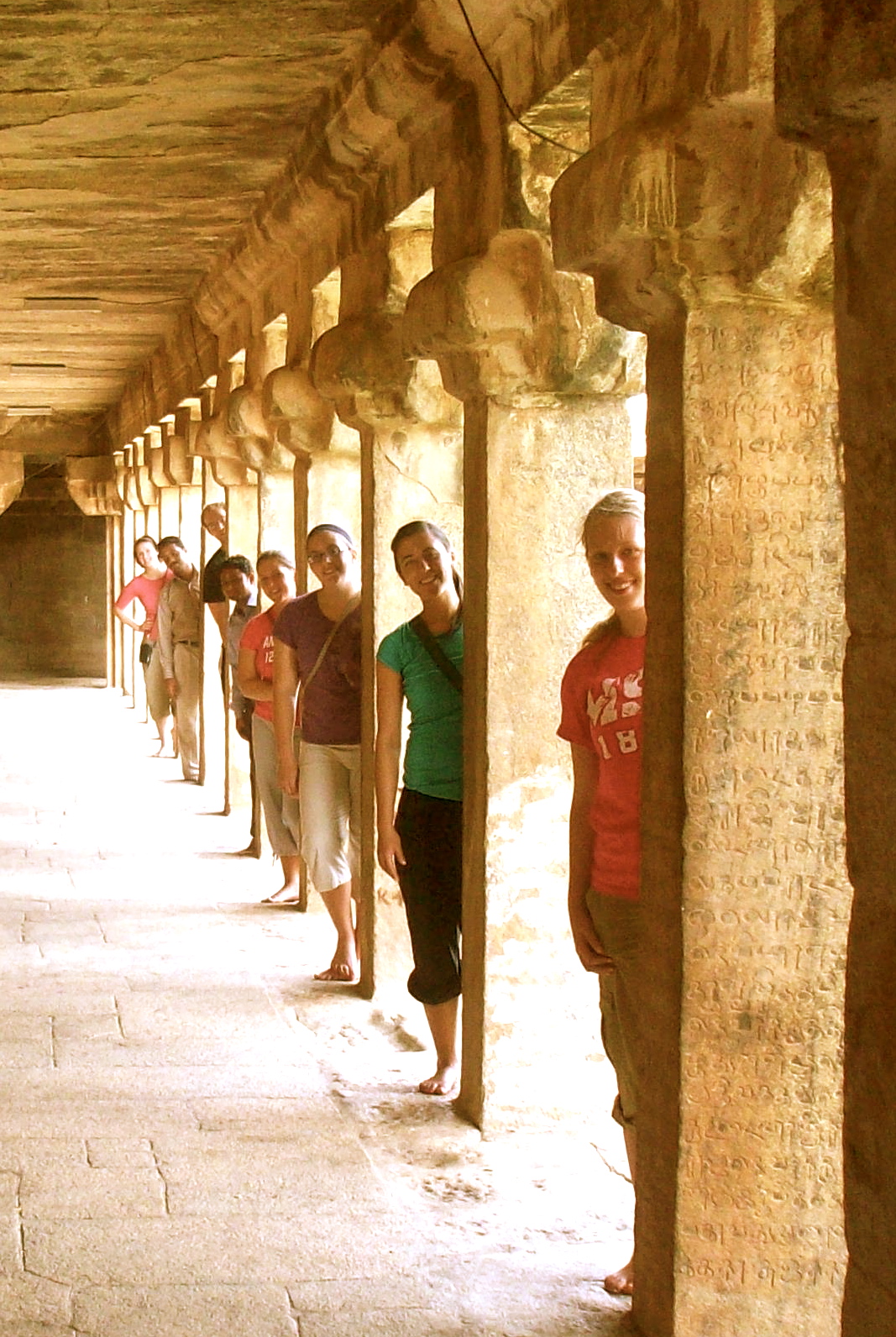
When we had wrapped up our temple sightseeing and were headed out we got the chance to ride an elephant!! I couldn’t pass it up, and hopped right up! It was an amazing view, and I can’t wait to do it again on our trip in Mudumulai!!!  All in all, it was nice to have a day to act like a tourist, and see what all India has to offer!  Now we are back at the hostel after quite a bumpy bus ride home, and I’m doing laundry, cleaning, and learning to play cricket today!! Should be fun! 


Here is me riding the elephant!!! So cool!!!
Oh! And although you are sleeping right now, Dad, I know it’s Father’s Day , so HAPPY FATHER’S DAY DADDIO!! I LOVE YOU!!!

Wedding Crashers!!!!


The bride and groom!

Wow it has been a crazy couple days!!! A lot of interesting things have happened all starting with yesterday morning.  We got up early to go to one of Dr. MohanKumar’s friends’ weddings.  In India, the weddings are all day affairs, but the most important rituals happen from 7-8:30 in the morning!! All of us girls got up at around 5 to get ready, and get wrapped up in our saree’s, then we headed to the wedding.  As soon as we got into the wedding hall, I knew that it was going to be like nothing I had ever seen.  When we walked in, 2 younger girls gave us all roses, handed us sandal paste to put into our palms, and made us eat a couple of grains of sugar.  Then we walked into the room, and immediately a traditional Indian band began playing really loud beautiful music.  Then we looked up to a very crowded stage full of the bride, groom, their families, and the priests and other special people.  There were many, many rituals going on, and Dr. MohanKumar was attempting to tell us about each one.  It was sort of a bizarre experience for all of us, because compared to American weddings, the two are not only not on the same page, they are not even in the same library!  The guests mingled with eachother as the wedding was proceeding, and there was breakfast being served in a different room at the same time.  Then, at an important ritual, such as tying the knot (literally the groom ties a necklace into a knot around the bride’s neck) people really pay attention, and the music blares.  Definitely an interesting experience!!!  After the wedding we came back to the hostel to prepare for our trip to Tanjoor.  Pam and I laid out in the sun, went on a 2 mile run in the 100 degree heat, and packed our things to go on the bus. 

The Bride!
The bus ride was an experience in itself.  We arrived at the bus station at 9:00 p.m. for a 9:45 bus.  We rode on a sleeper bus, where literally the whole bus is full of little beds.  Pam and I shared a bed, but neither of us slept a wink because it was bumpy, cell phones were ringing, there was stops and go’s, and most of all it was FREEZING!!!  All of us were really happy when we arrived in Tanjoor this morning, and checked into our hotel.  If there is one thing that I will take away from this trip it will be a pure appreciation for America, and a true feeling that I am one of the luckiest people in the world to be able to live in a land as great as the USA!

Us girls in our beautiful sarees!


We got a couple of hours of sleep, and then met for breakfast.  After a good breakfast we headed out to the villages to hit up some farms to get brucellosis/tuberculosis milk and blood samples, along with getting information for our mastitis project.  Our goal was to get 25 samples from all of the farms, and I just finished entering the data in the computer and I am proud to say that we collected 40 samples today.  We worked really hard!!  We used up all of our blood tubes, and even had to use some of our smaller milk tubes, and fill up 4 instead of 1 per cow.  We also saw some really really cute calves, met some really nice people, had tea in a village, listened to a villager sing us a folk song, and ate coconut water right out of the coconut!!!  It is unbelievable how hospitable the people in the villages of India are, when they seem to have so little, but in fact, they do not see it that way at all because I think they are really a happy people, and fully enjoy the lifestyle they live.  There is definitely something to say for enjoying your life versus having every material thing you could have.  Now I am relaxing in the hotel room, but dinner is soon so I gotta scoot! I’ll write more tomorrow!

Tuesday, 12 June 2012

Team Lab Rat ;)

Here is the group of us in front of the vet school
Ok everybody, here is some of the stuff that I've been up to :)

This is the Rose Bengal Plate Agglutination Test for Brucellosis (RBPT).  The top middle well is a positive result.

This is a Milk Ring Test (MRT).  If you see a straight pink column like the one on the left, it is a negative result.  However, if there is a ring at the top, as in the second from the left and middle, it is a positive result.  The tube on the right is the antigen we use.  This test can cause false positive results, and that is one reason why we use more than one test to determine if the cow is positive.  This test shows us that the positive result cows can be suspect for brucellosis.

This is me pipetting a milk sample into a tube for PCR.  I am working with Dr. Giri.  Things in labs here are a little different than back at home, but they still manage to get everything they need done.

Monday, 11 June 2012

Far and away the best prize that life has to offer is to work hard at work worth doing.


June 11,2012

This is the very first cow that we worked on. Poor girl just
calved about 5 hours ago.
Today was our first day at the clinic, and I have to say, it was amazing! I learned so much, just from the few animals that we saw.  Our objective for our bovine tuberculosis/brucellosis project was to collect blood, serum, and milk samples from any cows that we could at the clinic.  Our first case of the day was a cow that had just had a calf that morning, and had a large laceration on the left front teat of its udder.  Apparently, the laceration was related to the calving, and it was also leaking fluid out of its vulva that was reddish and sticky looking (due to calving). 

After that I made my first attempt at getting a blood sample.  I ended up getting the needle in, and popping the vacutainer on, however, she struggled, and when she did, my needle pulled out.  

I made Daryl stand next to a cow to show how small
the cows are here compared to the US.
I was frustrated with myself, but Dr. MohanKumar said that I had done great for trying to pull blood on a water buffalo because apparently their veins are really hard to get to.  I realized later that he was right, because the veterinarians at the college tried at least 6 or 7 times before they actually got a stick.  We collected those samples and then moved on to our next case.
This is the water buffalo that I attempted to pull blood on.

Our next case was a cow that appeared to be going blind in both of its eyes, anemic, and it was also crawling with ticks.  In India, ticks are really hard to control, and seem to be a difficulty to treat.  At first it was suspected that the animal had anaplasmosis, which is a blood borne protozoa, caused by ticks, but later it was suspected that the animal had a blood borne pathogen called theriosmosis (sp?).

This is me with the cow that was blind!
Our next case was a Holstein cross that had abdominal distention that was thought to be caused by a rumen infection.  After collecting samples from that, we were taken into the gynecology and obstetrics clinic to look at a cow that had had a mummified calf taken out by cesarean section 4 days ago.  Here is the rundown…the cow was brought in at 6 months gestation after a hard mass was felt during rectal palpation.  The cow was dilated to 1 cm, and upon sonograming, the fetus was pronounced dead.  She was given PGF2a to lyse the corpus luteum, and induce abortion.  She was then given estrogen to prime her structures so that oxytocin, a hormone used for milk letdown and birthing, could take effect.  After that, she was given an inverted L nerve block, and an incision was made on the left side of her body as to avoid the duodenum (part of the small intestine), and to be able to differentiate between the uterus and the rumen, all the while avoiding the omentum.  Then, the mummified calf was taken out, and she was sewn up.  There are many reasons why this calf could have been mummified, but nothing had been figured out yet.  I realize that a lot of you reading this blog have no idea what any of this means, but please know that this is a way for me to journal about the things that I have done as a way to remember them for future cases J

After that, we sampled 3 cows that were all presenting the same problems.  All had calved within the last 2 months, had gone off feed, and their milk yield had dramatically dropped.  These are all classic signs of ketosis.  When cows are milking, they are diverting a lot of their nutrients, and fat into the milk they make.  Therefore, when cows go off feed, they still keep diverting nutrients to that need instead of their bodies, and they mobilize fat.  An intravenous injection of dextrose will generally fix the ketosis, but the bigger question that one must find the answer to is, “Why did the cow go off feed in the first place?”  You can fix the ketosis, but sometimes if you don’t find the root of the problem, it will keep happening. 
This is a native breed of horse that they have here in India.
I'm not sure what it is called exactly, but its ears turn in
to face each other, which is strange, and they have really
long legs!


This is a picture of a Brahman bull.  He was not very happy when
they were working on him, and was actually quite scary at times!

We also got to see a few goats that had impactions, which is common in India because they eat a lot of garbage, and one of them had a palpable impaction the size of a baseball!  After we had collected as many samples as we could, and collected the medical histories, we came back to the hostel for lunch.  After lunch we are going back to the clinic to run milk ring tests to test for brucellosis, and to extract DNA from the milk samples.  Should be a fun rest of the day!